

















This year's Lunar New Year holiday witnessed a strong recovery and acceleration of the tourism industry in many localities. From the northern mountainous regions to the central and southern coastal resort centers, the accommodation market recorded high occupancy rates during the peak days from the 2nd to the 4th day of the Lunar calendar. According to a survey on the morning of February 14 by Mustgo – a booking platform cooperating with over 2,000 hotels nationwide – many accommodation facilities reached 80-95% occupancy, even fully booked in a short period.
Sa Pa continues to be the top choice for Northern tourists thanks to its proximity to Hanoi and convenient travel by private car. The 3-star hotel segment reached about 80% occupancy during February 18-20 (2nd-4th day of Tết), while other days ranged from 40-60%. In the 4-5 star segment, the occupancy rate reached up to 90%; some facilities reported being "fully booked" during the peak period. This indicates that the trend of high-quality resort tourism continues to be popular at the beginning of the year.
The customer market structure in Sa Pa also saw a positive shift as the ratio of international and domestic tourists became increasingly balanced. Data from the Agoda platform released on January 7 shows Sa Pa as Asia's fastest-growing destination in 2025, based on international tourist bookings over 11 months compared to the same period in 2024. The strong increase came from Southeast Asian and Asia-Pacific markets, notably India (up 207%), the Philippines (115%), Australia (104%), and Taiwan (76%). These figures solidify Sa Pa's position on the regional tourism map.

Sun World Fansipan Legend is a leading destination in Sapa.
In Ha Giang, the number of visitors began to increase rapidly after the second day of Tet. Many hotels in Meo Vac and Dong Van are fully booked; specifically, the Lo Lo Chai area is fully booked until around the 8th day. Due to the surge in demand, accommodation providers advise tourists to carefully check room availability and confirm directly with the accommodation, especially when booking through intermediaries, to avoid being left in a passive situation upon arrival.
If the northern mountainous region maintains a stable growth rate, Phu Quoc continues to be the focus of the beach resort market during Tet. Most accommodation establishments on the island achieved over 95% occupancy, reflecting high demand from both domestic and international markets. Specifically, the 4-star segment in the center of Duong Dong had almost no rooms left during peak days. A representative from Wyndham Grand Phu Quoc – the largest accommodation facility in the special zone – stated that the occupancy rate during this period is equivalent to New Year's Day, with international guests accounting for a large proportion and Vietnamese guests making up a small portion.
Phu Quoc's growth momentum is not only reflected in the accommodation system but also clearly reflected in aviation activities. On February 14th, Phu Quoc International Airport recorded 86 arrivals, including 50 international flights – the highest in a single day since the airport began operations in 2012. This is a new record during the peak period leading up to the Lunar New Year.
The total number of passengers for the day reached 30,651. International passengers alone reached 18,271 (9,582 arrivals and 8,689 departures), accounting for nearly 60% of the total passenger volume; domestic passengers reached 12,380. This structure shows that the international market is playing a crucial driving role for the tourism of the pearl island, and simultaneously affirms Phu Quoc's position as a regional beach resort hub.
According to the operational plan for the 2026 Lunar New Year period, the total number of flights through Phu Quoc airport is expected to increase by about 50% compared to Tet 2025, with an average of 75 flights per day; peak days potentially reaching 80-84 flights per day. Passenger volume is projected to exceed 720,000 during the holiday, with strong growth in both domestic and international segments. This is a notable growth amidst a strong recovery in early-year travel demand.
To meet the increased operational volume, Phu Quoc International Airport proactively develops synchronized and flexible operational plans, enhances personnel and equipment, and reviews infrastructure and processes to optimize service capacity. Areas prone to congestion, such as check-in counters, security screening areas, and baggage carousels, are reorganized more scientifically. Personnel are deployed in increased numbers during peak hours, ensuring timely handling of emerging situations and maintaining smooth passenger flow.
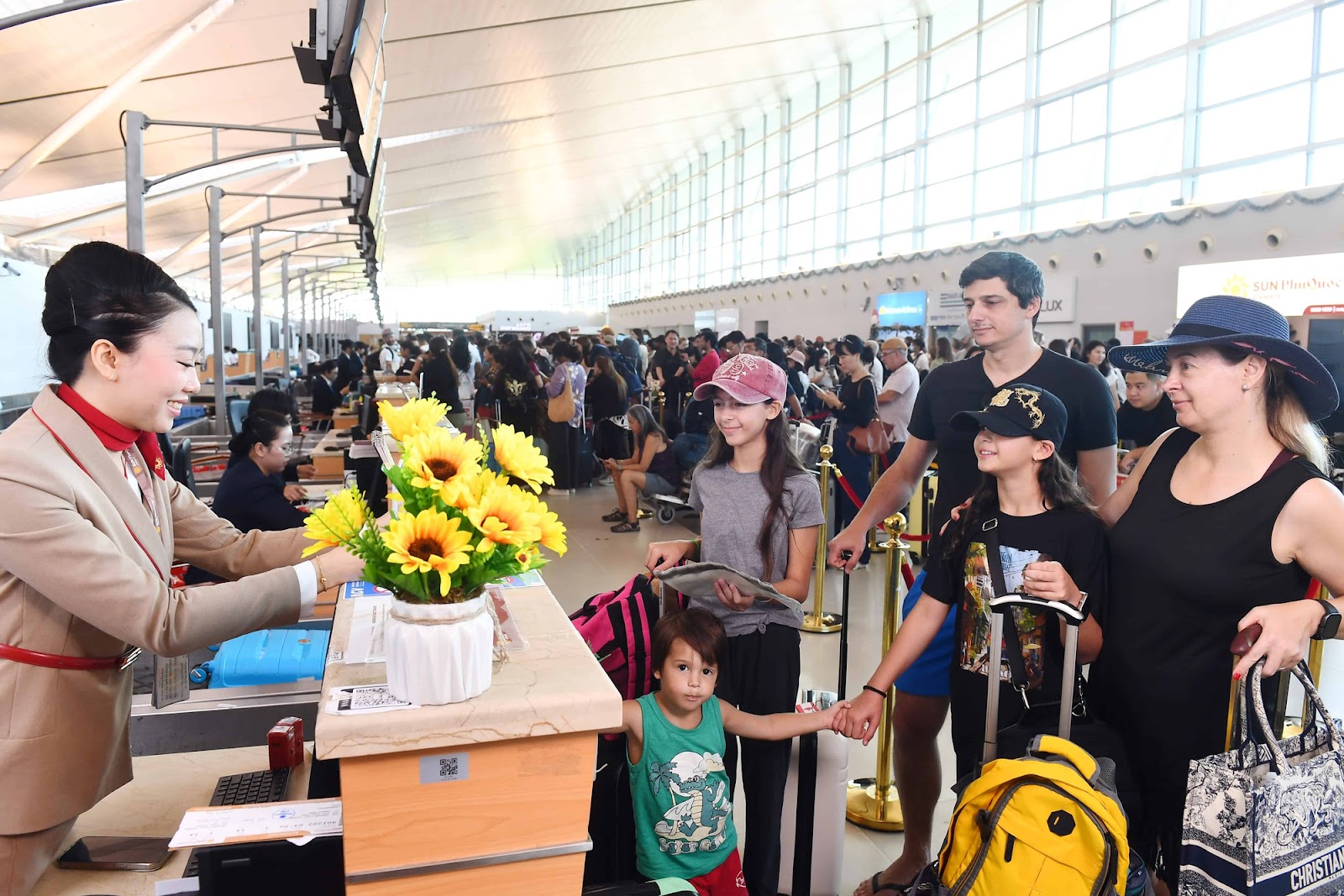
International tourists at Phu Quoc airport are increasing.
Concurrently, many service quality improvement items are being implemented, such as adding Wi-Fi systems, upgrading signal boosters, enhancing flight information display screens, and adding check-in counters and baggage conveyor belts. From January 1, 2026, the automatic non-stop toll collection method will be applied to reduce congestion and improve operational efficiency. From early 2026, Sun Group Corporation will officially take over operations and invest in upgrading and expanding the port, aiming to increase service capacity to 20 million passengers per year ahead of APEC 2027, creating a long-term foundation for tourism growth.
In Quang Ninh, data from Mustgo shows that Chinese tourists accounted for a large proportion during Tet, while Vietnamese tourists were limited due to unfavorable weather conditions for sea activities. Overall room occupancy reached about 40-60%, with many hotels proactively waiving holiday surcharges to stimulate demand. Specifically, Yoko Onsen Quang Hanh and Legacy Yen Tu & Lang Nuong Yen Tu recorded high occupancy rates, mostly fully booked during February 18-20, demonstrating the appeal of wellness retreat and spiritual tourism products.
In Hanoi, the accommodation market during Tet was relatively quiet compared to resort destinations. The central area achieved 50-60% occupancy, mainly serving international guests. Hotels outside the center launched promotional programs to attract domestic tourists for spring travel, with occupancy reaching about 50%.
Central Vietnam continues to see Da Nang as the leading destination, despite flight ticket prices doubling compared to normal days. Coastal hotels achieved 80-90% occupancy, with almost no rooms left from the 2nd to the 4th day of Tet; the inner city area reached over 80% for international brands thanks to an inbound guest ratio of about 80%, while local brands were below 60%. Hoi An is currently at about 50% occupancy, not yet entering its peak season.
Hue recorded many accommodation facilities reaching over 90% occupancy during peak days. According to the Hue City Department of Tourism, the locality has over 4,300 accommodation rooms with an average occupancy of 67% during the holiday; specifically, the 4-5 star segment and homestays in the central area reached over 90% from the 2nd to the 4th day of Tet.
In the South, Phan Thiet continues to be the most searched beach destination according to Booking data released on January 25. Mustgo reported that most accommodation facilities reached about 80% occupancy, with the 3rd and 4th days of Tet being fully booked. The former Vung Tau area (now part of Ho Chi Minh City) showed improvement compared to the same period last year, with many hotels fully booked during peak times, and other days reaching 70-80%. Da Lat was also almost fully booked on the 3rd-4th days of Tet, with other days reaching 85-90%.
Overall, Tet tourism in 2026 shows steady growth across regions and market segments. Among them, Sa Pa and Phu Quoc stood out with high occupancy rates and strong participation from international tourists. Specifically for the pearl island, a record of 50 international flights per day and passenger volume exceeding 30,600 in a single day clearly demonstrates the growing appeal of a destination with synchronized infrastructure and global connectivity.