















1. What is the Sa Pa Jumping Tet Festival? Origin and outstanding features
1.1. General introduction to the Sa Pa Jumping Tet Festival
The Sa Pa Jumping Tet Festival, also known as the Put Tong Festival, is an important traditional ritual in the spiritual life of the Red Dao people in Lao Cai. Recently, the festival was held on February 15–16, 2025, in May village, Sa Pa, Lao Cai province, attracting the participation of many local people and thousands of visitors from all over.
The festival takes place in a lively early spring atmosphere, serving as an occasion for the Red Dao community to perform rituals that signify warding off bad luck, praying for luck, health, and favorable weather (rain and wind), as well as praying for the souls of the deceased and for peace for the living.
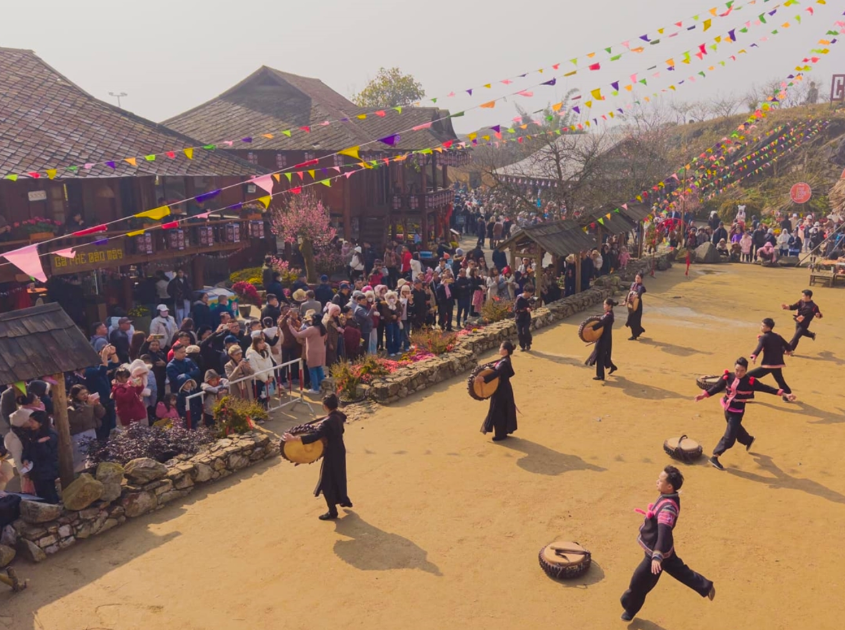
The festival takes place in the bustling atmosphere of early spring. (Source: Collected)
A notable highlight of the Tet Nhay Festival in Sa Pa is the venue located at the foot of Fansipan mountain, an area closely associated with the long-standing residence of the Red Dao ethnic group. Connecting the festival activities with Sun World Fansipan Legend tourist area contributes to expanding the experiential space, while creating a majestic natural backdrop, enhancing the sacredness and solemnity of the traditional rituals.
Regarding preservation value, the Put Tong Festival of the Red Dao people has been included by the Ministry of Culture, Sports and Tourism in the List of National Intangible Cultural Heritage. This recognition affirms that Tet Nhay is not merely a performance for tourism, but an important ritual preserved, practiced, and passed down through generations by the community.
1.2. Origin and meaning of the Put Tong Festival (Tet Nhay)
The Put Tong Festival holds a particularly important position in the ancestor worship belief system of the Red Dao community in Lao Cai. This is a ritual with deep spiritual significance, associated with the belief in ancestors and protective deities, preserved and passed down through generations within families.
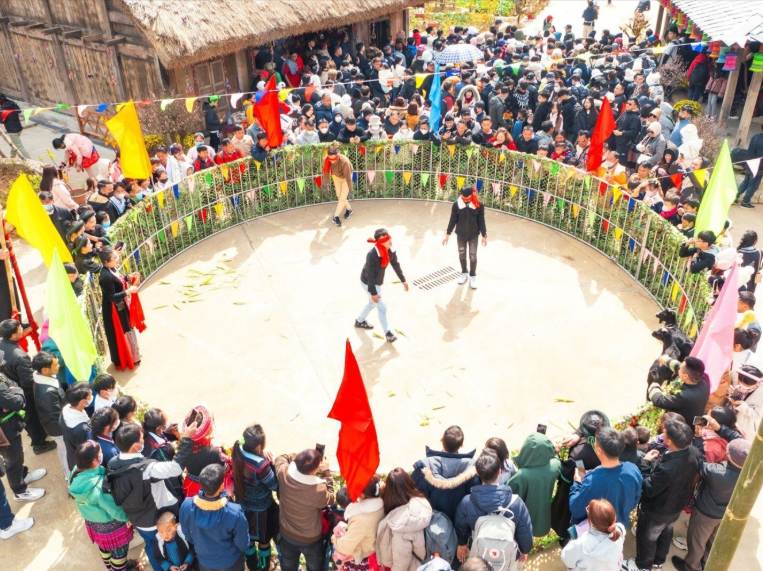
The festival is held with the aim of praying for luck, health, and favorable weather. (Source: Collected)
In terms of meaning, the Tet Nhay (Jumping Festival) festival converges the sacred aspirations of people at the turn of the new year. The festival is held with the aim of praying for luck, health, favorable weather, and peace for the community. At the same time, it is also an occasion to pray for the souls of the departed, demonstrating the principle of "when drinking water, remember its source", expressing filial piety towards ancestors, and conveying good wishes for the living.
Regarding the name, in the Dao language, "Pút" means jump, and "Tồng" means field/plain. The concept Pút Tồng therefore refers to both the ritual of worshiping - remembering the souls of ancestors, and encompasses a characteristic performance form, in which ritual dances are practiced throughout the ceremony. The name "Tết Nhảy" in Vietnamese originates from this characteristic, emphasizing the central role of ritual dances.
3. What makes the dances in the Sa Pa Tet Nhay unique
3.1. The 11-step ritual - the soul of the Tet Nhay
The center of the Sa Pa Tet Nhay festival is the 11-step ritual, an important ceremony directly performed by experienced Dao Do shamans and artisans. These are the people who hold the core spiritual knowledge of the community, understand the system of prayers, the sequence of rituals, and the sacred dances, playing the role of guiding the entire festival space.
The performance of the 11-step ritual has unique characteristics difficult to find elsewhere. While participating, members sway to the rhythm of drums and gongs, offer prayers, showing reverence for deities and ancestors. The dance movements are continuous, blending together to create a lively atmosphere.
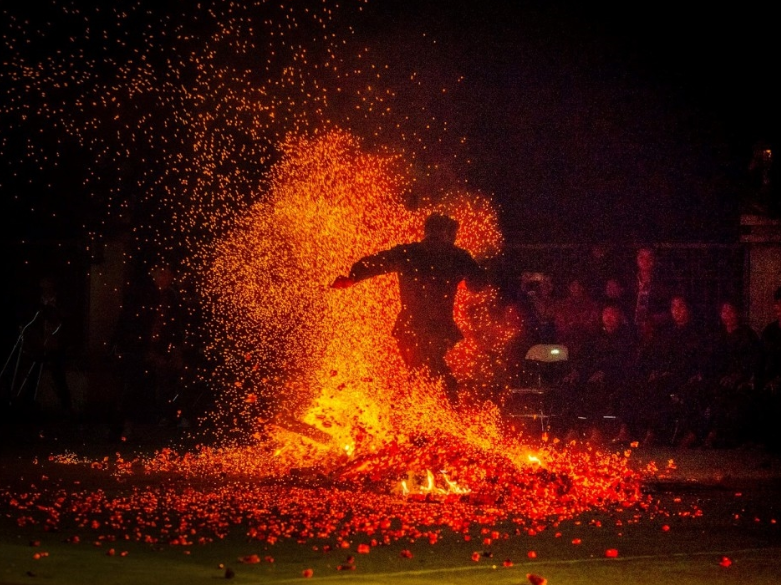
The center of the Tet Nhay Sa Pa festival is the 11-step ritual. (Source: Compilation)
The sound of drums and gongs echoes rhythmically, along with the steps of the ritual performers, creating the characteristic ritual space of Tet Nhay Sa Pa . Each dance is not just a performance but also recreates slices of life of the Red Dao community.
3.2. Unique "charcoal bathing" ritual
One of the most impressive highlights of the Tet Nhay Sa Pa festival is the "charcoal bathing" ritual, a ritual deeply symbolic of the Red Dao community. The ritual sequence begins with a prayer ceremony led by the shaman, offering prayers to the deities of heaven, earth, mountains, and rivers, with wishes for protection and blessings for the ritual participants.
After the ceremony, a fire is lit, the wood burns brightly and gradually turns into glowing red embers. The climax of the ritual occurs when young Red Dao men perform the fire dance, dancing on the hot embers amidst the pounding drums and gongs. The powerful, decisive steps amidst the blazing embers captivate the onlookers' attention, evoking a sense of awe at the courage and absolute focus of the ritual performers.
3.3. Reenactment of the traditional Red Dao wedding ceremony
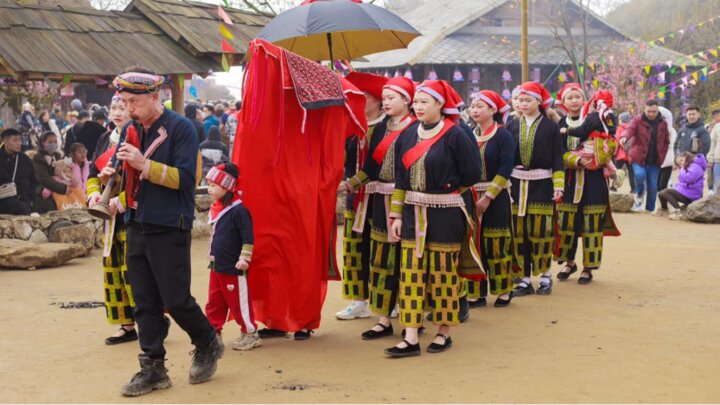
The Tet Nhay Sa Pa festival also expands the depth of cultural experience with the reenactment of the traditional Red Dao wedding ceremony taking place right in May village. The program is coordinated by Sun World Fansipan Legend, inviting local artisans to perform, contributing to bringing traditional marriage rituals closer to tourists in the spring festival atmosphere.
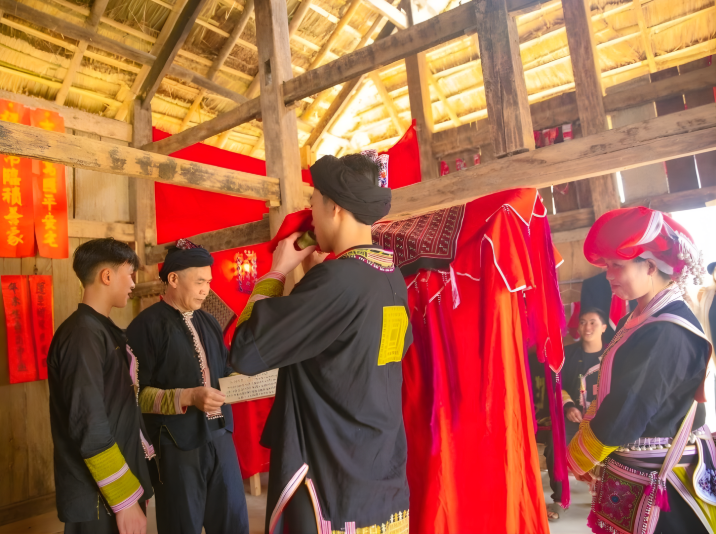
Visitors have the opportunity to immerse themselves in the atmosphere of a traditional wedding. (Source: Collection)
Through reenactment activities, visitors have the opportunity to immerse themselves in the atmosphere of a traditional wedding, where costumes, rituals, and props are deeply imbued with the ethnic group's cultural identity. Seemingly simple details clearly reflect the concepts of family, marriage, and community cohesion in the spiritual life of the Red Dao people.
3.4. Folk Games and Ethnic Arts
Besides solemn spiritual rituals, the Sa Pa Tet Nhay festival also creates a vibrant atmosphere thanks to a series of folk games and traditional art performances. Familiar games such as 'nem con' (ball tossing), tug-of-war, stilt walking, and jump rope are organized alternately within the festival space, bringing a cheerful mood and creating opportunities for local people and tourists to interact and connect.
Alongside the games are performances of traditional instruments, flutes, folk singing, and dancing by Red Dao artisans and representatives of some other ethnic groups in the region. The rustic sounds of traditional instruments and characteristic folk melodies lead visitors into a rich folk music world, reflecting the abundant spiritual life of the highland communities.
The festival space is also made more complete with traditional cuisine introduced during the early spring. Dishes with strong mountain flavors such as local pork, free-range chicken, grilled dishes, and corn wine contribute to a perfect spring travel experience, helping visitors feel the daily life of the Red Dao people more clearly.
4. Experience attending the Sa Pa Tet Nhay festival
To make the journey of exploring the Sa Pa Tet Nhay festival complete, visitors should prepare clothing suitable for the early spring highland climate. The first months of the year in Sa Pa are often cold, with fog and drizzle, so wearing multiple layers of warm clothing and sturdy, non-slip shoes will help ensure safe and comfortable movement within the villages and festival areas.
Essential items such as waterproof jackets, woolen hats, gloves, and scarves should be brought when participating in outdoor activities. Cameras or phones with power banks help capture impressive moments of rituals, dances, and the colors of ethnic costumes. Visitors should also prepare some small denomination cash for convenience in purchasing food and souvenirs at the stalls in the village.
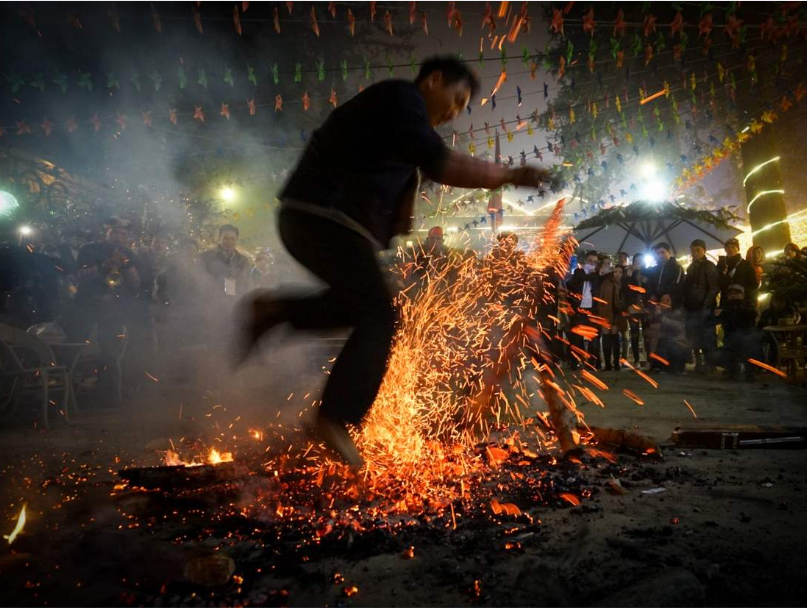
Visitors should not participate in rituals such as fire dancing or coal bathing without permission. (Source: Collected)
Throughout the festival, respecting the spiritual space of the Red Dao people is especially important. When main rituals such as the 11-step ritual are performed, visitors should maintain a serious attitude, limit noise, avoid crowding, or standing too close to the ritual area and offerings.
In addition, visitors should pay attention to dressing appropriately, communicating politely, maintaining general hygiene, and respecting the daily life of the local people. Especially, do not participate in rituals such as fire dancing or coal bathing without guidance, to ensure safety and contribute to preserving the traditional beauty of the festival.
The Sa Pa Tet Nhay Festival opens a journey to the highland culture, where each dance, each ritual carries ancestral memories and the enduring faith of the Red Dao community. Therefore, coming to Sa Pa in the early days of the year, immersing yourself in Tet Nhay, is the most complete way to feel the spiritual beauty preserved through generations!